
Published November 4, 2026
Using Home Equity to Pay Off Credit Card Debt in Oklahoma

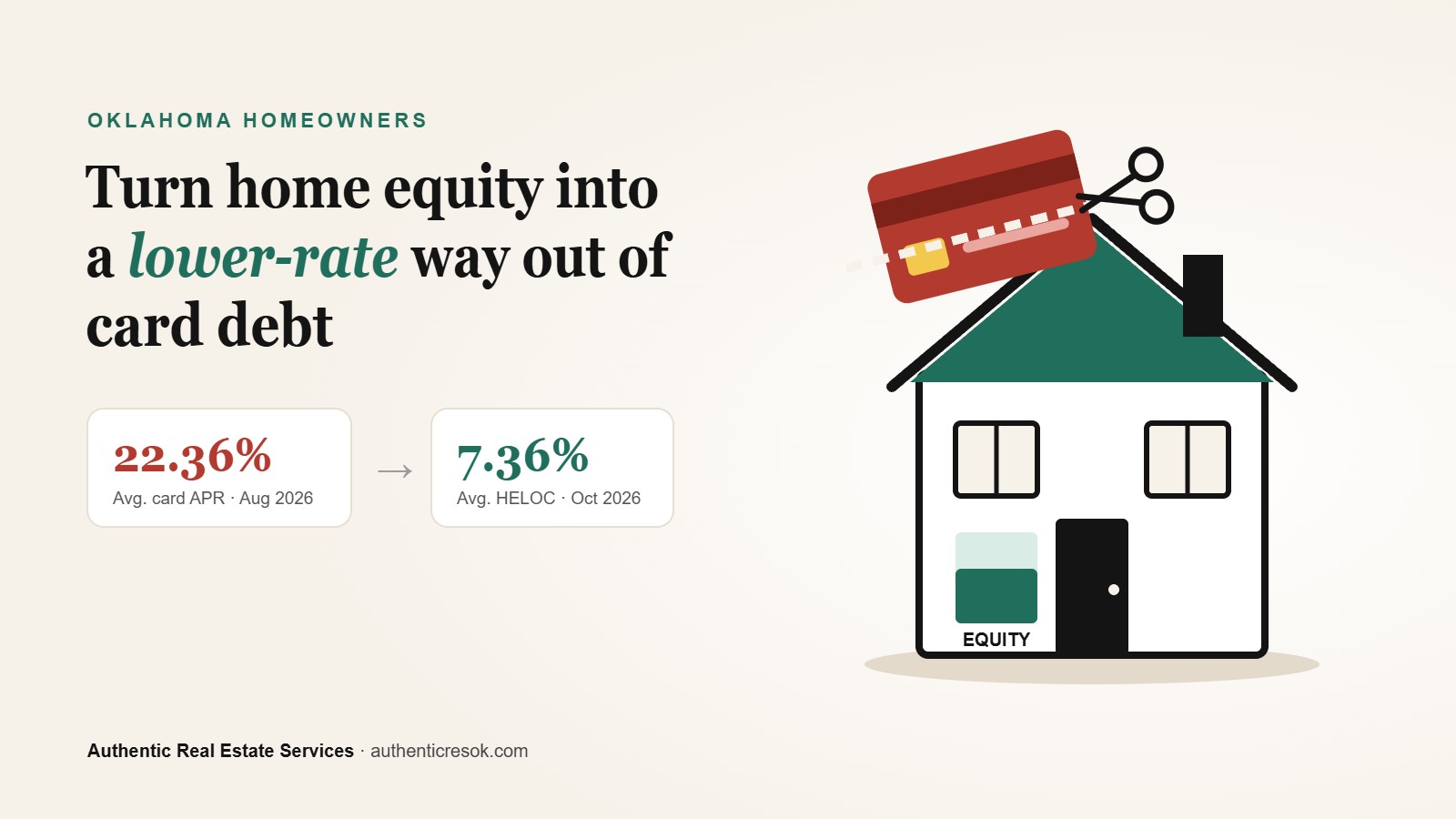
If you own a home in Oklahoma and carry credit card debt, your house may offer a cheaper way to pay it off. Credit cards that charge interest averaged 22.36% in August 2026, while the national average HELOC rate was 7.36% in late October. Borrowing against your home equity to pay off those cards can cut your interest cost sharply, but it also puts your home on the line, so it's worth understanding before you act.
What is home equity?
Home equity is the part of your home you own outright: its market value minus what you still owe on the mortgage. If your home is worth $300,000 and you owe $180,000, you have $120,000 in equity.
American mortgage holders had a record $18 trillion in equity in mid-2026. About $11.7 trillion of that is "tappable," meaning it could be borrowed while still keeping 20% equity in the home. That works out to roughly $212,000 per borrower nationally. Oklahoma homeowners typically hold less: Oklahoma was one of four states where fewer than 35% of mortgaged homes were "equity-rich" at the end of 2025, compared with 44.6% nationwide. Your own number depends on your home's value today, which is why it's the first thing to check.
Three ways to use your equity
| Option | How it works | Rate type | Best for |
|---|---|---|---|
| HELOC (home equity line of credit) | A credit line secured by your home; you draw what you need | Usually variable | Paying down debt in stages |
| Home equity loan | A lump sum, repaid in fixed monthly payments | Usually fixed | One payoff with a set payment |
| Cash-out refinance | Replaces your mortgage with a larger one and pays you the difference | Fixed or adjustable | Only when the new mortgage rate is close to or below your current rate |
If you have a low mortgage rate from earlier years, a cash-out refinance usually doesn't make sense, because you'd trade that low rate for today's rate on your whole balance. A HELOC or home equity loan leaves your first mortgage alone. For context, the average 30-year fixed rate closed October at 7.27%, the lowest since late September.
What the math can look like
Here's a simple illustration, not a quote. Say you carry $25,000 on credit cards at 22.36%. That balance costs about $5,590 a year in interest. The same $25,000 at a 7.36% HELOC rate costs about $1,840 a year, a difference of roughly $3,750. Your actual rate depends on your credit, your equity, and the lender, and closing costs or fees reduce the savings.
Before you tap your equity
- Your home becomes the collateral. Credit card debt is unsecured; a HELOC or home equity loan is secured by your house. Missing payments can put your home at risk.
- Variable rates can rise. Most HELOCs float with the prime rate, so your payment can go up. The Federal Reserve held rates steady in late October, but strong growth and firmer inflation have put a possible December rate increase on the table.
- It only works if the cards stay paid off. Moving the balance to your home and then running the cards back up leaves you with more debt, not less.
- Fees and closing costs vary. Compare the full cost from at least two or three lenders.
- Know your home's value first. Lenders typically let you borrow up to 80–85% of your home's value, minus what you owe, so an accurate value tells you what's realistic.
Frequently asked questions
How much equity can I borrow?
Most lenders allow a combined loan amount of up to 80–85% of your home's value. On a $300,000 home with a $180,000 mortgage, an 80% limit would mean up to about $60,000.
Will tapping equity hurt my credit?
Applying causes a hard credit inquiry, and you'll take on a new account. Paying off high card balances can lower your credit utilization, which often helps over time.
Is interest on a HELOC tax-deductible?
Generally only when the money is used to buy, build or substantially improve the home, not to pay off credit cards. Ask a tax professional about your situation.
Does this affect selling my home later?
Yes. A HELOC or home equity loan is paid off from your sale proceeds at closing, so it reduces what you walk away with.
Start with what your home is worth
The first step is knowing your home's current value and how much equity you really have. Get a free home value estimate, or talk with our team about financing options. We'll help you see the numbers and connect you with a licensed lender who can walk you through your choices.
This article is for general education and isn't financial, tax or legal advice. Authentic Real Estate Services is not a lender. Rates change often; talk with a licensed loan officer and a tax professional about your situation.
